
Can You Add Tile Trim After Tiling?
For contractors, builders, and property managers, a completed tiling project that lacks a finished edge can present a common challenge. Exposed raw tile edges are not only a visual flaw but also a point of vulnerability for chipping and moisture ingress. The question often arises after the fact: can you add tile trim after tiling? The direct answer is yes, it is possible through a process known as retrofitting.
This guide will explain the practicalities of retrofitting tile trim, outlining the methods, suitable products, and key considerations to ensure a durable and professional-looking result, even when modifying an existing installation.

Understanding Retrofit Solutions
Retrofitting involves adding or upgrading components to an existing structure after its initial installation. In the context of tiling, it means applying edge profiles over already-set tiles. While the ideal and most robust method is to install the trim’s anchoring leg beneath the tile in the setting bed, retrofit options provide a viable alternative to correct oversights, upgrade aesthetics, or repair damaged edges without a full tear-out.
The primary advantage of retrofitting is flexibility. It allows for aesthetic updates or functional improvements with minimal disruption. However, it’s crucial to understand that retrofit trim relies on surface adhesion rather than mechanical lock-in, making product selection and installation technique paramount for long-term success.
Read more:
Two Main Methods for Retrofitting Tile Trim
The approach you choose depends on the available space and the type of edge you need to finish.
1. Surface-Mounted (Overlay) Trim
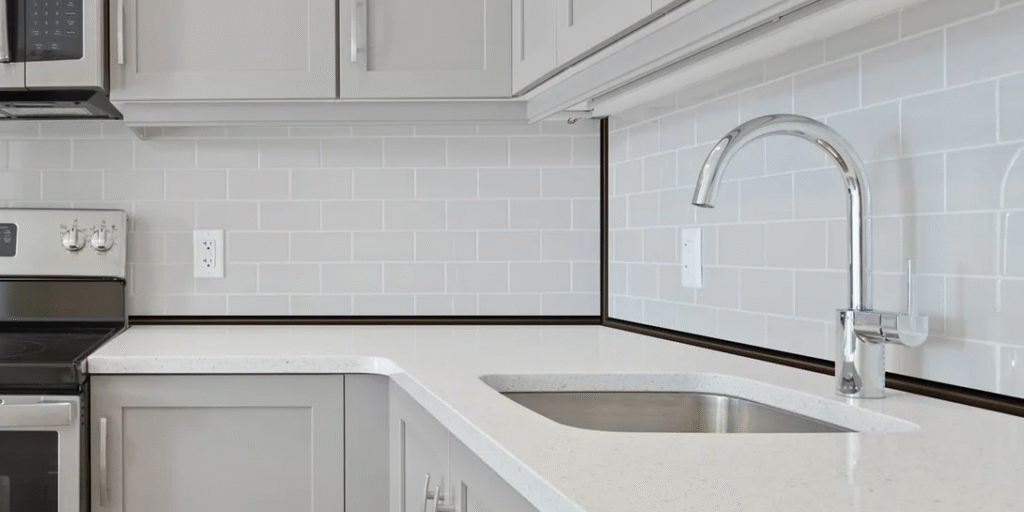
This is the most common retrofit method. A profile with an adhesive backing or one designed for surface application is fixed directly onto the face of the tile and the adjacent wall or floor.
Best For: Covering exposed edges where the tile meets a different material (e.g., the top edge of a kitchen backsplash or a shower curb). It’s also ideal for adding corner protection to vulnerable external corners.
Key Consideration: It will create a slight reveal or “step” on the surface. The bond integrity depends entirely on the strength of the adhesive and surface preparation.
2. Insertion (T-Slot) Trim
This method uses a T-shaped profile. The vertical leg of the “T” is inserted into the existing gap (grout joint) between the tile and the adjacent surface, while the horizontal top covers both edges.
Best For: Creating a clean transition between two finished surfaces, such as between a tiled floor and a wooden floor, or for finishing the front edge of a step (retrofit stair nosing).
Key Consideration: It requires a consistent and adequately sized gap (typically 3mm or more) to accommodate the profile’s anchoring leg. This method often provides a more secure mechanical fit than pure surface mounting.

Step-by-Step Guide to Retrofitting Trim
For a reliable retrofit installation, follow this professional process:
1. Select the Appropriate Retrofit Profile:
Choose a profile explicitly designed or suitable for retrofit applications, such as surface-mounted corners or T-slot transitions.
Material Matters: For wet areas, use stainless steel or anodized aluminum. For dry, decorative areas, powder-coated aluminum or PVC may be suitable. Ensure the profile’s height adequately covers the tile edge.
2. Meticulous Surface Preparation:
Clean: The tile edge and adjacent surface must be impeccably clean, dry, and free of grease, dust, soap residue, or old sealant. Use a degreaser and abrade glossy surfaces slightly to improve adhesion.
Measure & Cut: Precisely measure the required length and cut the profile using a fine-tooth hacksaw and miter box for perfect 45-degree corner joints. Deburr all cut edges.
3. Apply High-Performance Adhesive:
Do not rely on weak tapes. Use a premium, flexible construction adhesive specifically rated for bonding metal/polymer to ceramic/stone (e.g., a high-strength silicone or a hybrid polymer adhesive).
Apply a continuous, generous bead to the back of the profile.
4. Secure and Support:
Firmly press the profile into place, applying even pressure along its entire length.
Use painter’s tape or temporary clamps to hold it securely for the full adhesive curing time, as specified by the manufacturer. Do not disturb during this period.
5. Final Sealing:
Once the adhesive is fully cured, run a thin, neat bead of color-matched waterproof silicone sealant along any gaps between the trim and the tile to prevent water ingress and lock it in place.
Limitations and Professional Recommendations
While retrofitting is effective, acknowledge its constraints:
Longevity: A retrofit installation may not match the decades-long lifespan of a trim fully embedded in mortar.
Profile Limitations: Not all sleek, contemporary trim profiles are designed for retrofitting; options may be simpler.
Not for Structural Lippage: It cannot correct significant tile lippage (height differences between tiles).
Best Practice: For all new projects, always specify and install the tile trim concurrently with the tiling. This ensures maximum protection, the cleanest aesthetic, and the most durable result. View retrofitting as a valuable corrective or upgrade solution, not the primary installation method.
Conclusion: A Viable Solution with the Right Approach
Yes, you can successfully add tile trim after tiling. The key lies in selecting purpose-designed retrofit profiles, preparing surfaces with surgical care, and using industrial-grade adhesives. For contractors, this capability is a powerful tool for renovation projects, warranty work, and client upgrades.
If you’re looking for premium-quality tile trims to complete your project, check out our extensive range of tile trim for every style and requirement. If you need some expert technical advice you can speak to our experienced sales team on +86 18925917775 or via email rongyi093@gmail.com.